First objective of the JISC-supported Sonex initiative was to identify and analyse deposit opportunities (use cases) for ingest of research papers (and potentially other scholarly work) into repositories. Later on, the project scope widened to include identification and dissemination of various projects being developed at institutions in relation to the deposit usecases previously analyzed. Finally, Sonex was recently asked to extend its analysis of deposit opportunities to research data.


Showing posts with label Conferences. Show all posts

Saturday, 11 February 2012

SONEX work on repository interoperability to be presented at the 2nd Open Access Forum


  The communication "The SONEX Workgroup for the Analysis of Repository Interoperability Issues: a Summary of Activities" (in Spanish) presented by the JISC-funded SONEX Workgroup has been accepted for the 2nd Open Access Forum to be held Apr 16-17th along the INFO2012 conference in Havana, Cuba. The motto for this 2nd Open Access Forum is "Interoperability: the Basis for the Ecology of Open Access Repositories".


The selected list of topics for the 2nd Open Access Forum includes:

  • Standards for Open Access Repository (OAR) Interoperability

  • CRIS/OAR Interoperability

  • Value-Added Services based on Repository Interoperability (such as Repository Usage Aggregation Systems)

  • Linked Data and Enriched Digital Objects

  • Integration of Repositories and Electronic Publishing Platforms

  • Semantic Interoperability

  • Interoperability between Open Access Repositories and e-Learning Platforms

  • Distributed Repository Networks

Tuesday, 13 December 2011

Thematic parallel session on metadata - actions to be taken


  On Day II of the JISC MRD Programme 2011-13 launch event in Nottingham, last Dec 2nd, specific subject-based discussion sessions were held among the different JISCMRD02 Projects for research data management in order to promote synergies and joint work on common issues. This is a brief report on the outcomes of such discussions at the parallel session on metadata - some other were simultaneously held for Institutional, Life Sciences, Engineering or Archaeology MRD projects, whose discussions have been reported elsewhere (and there are also other posts summarizing talks for this one too).

It was really hard for some of us to pick a single of those groups, since many projects actually belonged to several strands (some lucky ones had also two representatives at the event, it should be noted). The session on metadata was attended, among others, by:

- Anna Clements (U St Andrews)
- Simon Kerridge (U Sunderland)
- Kevin Ginty (U Sunderland)
- Charlotte Pascoe (British Atmospheric Data Centre)
- Pablo de Castro (SONEX Workgroup)
- Simon Hodson (JISC MRD Programme manager)
- David Shotton (U Oxford)
- Louise Corti (UK Data Archive)
- Marco Fabiani (Queen Mary U London)
...


Discussion

Metadata standards were repeatedly discussed along the session - there was a joint (and unsuccessful) attempt to recall whether anyone knew about a metadata standard registry available for different disciplines. Representatives from CERIF4Datasets Project, University of Sunderland, mentioned they were using the MEDIN metadata standard for their work in marine sciences data management. The Core Scientific Metadata Model (CSMD) standard, developed at STFC for the I2S2 Project was also mentioned as an interesting approach to multi-disciplinary metadata standard for structural sciences such as Chemistry, Materials Sciences, Earth Sciences or Biochemistry. Finally, the PIMMS Project (BADC/U Reading), mentioned Metafor as a Climate Science metadata standard and their goal of using PIMMS software tool to generate CIM-based content.

At some point the idea catched up that metadata standards should perhaps be mandated by publishers in order to harmonise discipline-specific data description procedures. Publishers are actually involved in several very successful international RDM projects, such as Dryad, but -save for REWARD- are significantly missing in JISCMRD02 projects.

Having previously developed the Semantic Publishing and Referencing (SPAR) Ontologies, David Shotton said he was now working on their extension to CERIF-based metadata description of datasets, which is closely linked to dataset CERIFication work being carried out at the CERIF4Datasets Project.


Actions

The following actions were proposed for improving the chances of metadata standard harmonisation - hence enhancing dataset discoverability:

  • Trying to locate (or otherwise collect) an already existing registry of metadata standards for different disciplines, in order to offer researchers from a given discipline an already tested metadata schema they can re-use,

  • Mapping metadata standards to each other aiming to produce a minimum-sufficient-information metadata set that may be widely applicable accross disciplines,

  • Taking steps towards organising a workshop in order to have metadata issues discussed among relevant stakeholders. ANDS Metadata Workshop in 2010 might be a potential source of inspiration for this with all those discipline-based approaches to metadata standards. Proposed dates for this Metadata WS were spring-summer 2012.


Finally, there was a wrap-up by different subject-based project groups which showed strong possibilites for a more stable cooperation among them (Biomedical/Healthcare projects even discussed the possibiity of building a common wiki). Some cooperation frameworks (googlegroups, mailing lists) might be set for promoting this disciplinar trans-project collaboration. Regarding the metadata strand, it should be noted it was also an issue in discussions held at most subject-specific workgroups, so it would potentially allow contributions from all of them.

Friday, 2 December 2011

The dawn of a new JISC MRD programme - Day I


  After a successful first stage of the JISC Managing Research Data (MRD) Programme (2009-2011), a second phase of JISC MRD was launched yesterday at the NCSL Conference Centre in Nottingham, along a 2-day event that will continue today. JISC MRD02 Programme includes 27 projects classified in three different strands:

Strand A. Research Data Management Infrastructure: 17 projects, to be completed from Mar to Jul 2013, comprising Institutional Pilot projects, Institutional Embedding and Transition to Service projects, Disciplinary projects for creative arts and archaeology, and a Metadata project,

Strand B. RDM Planning: 8 projects running until Mar 2012, aiming to design and implement data management plans and supporting services for researchers,

Strand C. Enhancing DMPOnline projects: 2 projects, aiming to customize and enhance the DCC DMPOnline Tool to improve its interaction with institutional/ disciplinary information systems).

It is worth noting that a number of funded RDM projects along this 2nd programme stage are building upon previous pilot work (projects carried out along JISC MRD programme 2007-2011) in order to for instance extend and embed data management services accross the whole institution.

On describing the research data management programme, Simon Hodson, JISC MRD programme manager mentioned there will be two further JISC MRD calls as early as Jan 2012, dealing with:

- Research data publications, aiming to build partnerships among involved stakeholders and encouraging data citation and publication,

- RDM Train, aiming to design and implement data management training strategies for specific disciplines and support roles (including librarians), to be performed by linking to professional bodies.

Emphasis will also be made along this 2nd JISC MRD programme stage on evidence gahering for project benefits and impact. A session devoted to these issues will be held on Dec 2nd, with practical work with both the Benefits Framework Tool and the Value Chain Impacts Tool. Developing metrics for measuring project impact is a specific programme goal along this 2nd implementation stage.

Project blogging

Another JISCMRD02 main objective -and closely related to impact measurement- is promotion of project dissemination and interaction among themselves and with the broader community via blogging. A specific presentation on 'blogging practices to support project work' was delivered for the purpose by Brian Kelly, UKOLN. The presentation highlighted the relevance of publishing project blogposts as an alternative means of expression to writing research papers or code, and engaged the audience in finding shared views regarding potential benefits blogging may bring to RDM projects, also providing some useful technical advice along the way.

Subsequent discussion focused on pros and cons of blogging as a communication technique (both from regular bloggers' and researchers' viewpoint), as well as on potential advantages of JISCMRD project blog aggregation, with a common RSS feed embedded back into the JISC site.

Parallel sessions and poster-session networking

Two parallel sessions came afterwards, dealing with two principal RDM issues: a first one on DCC Tools, introducing Data Asset Framework (DAF), DMPOnline and CARDIO, and summarized by Paul Stainthorp, U Lincoln, on his JISCMRD02 Day I blogpost.

The 2nd parallel session dealt with UMF Tools and related RDM projects. This 2nd session featured presentations by John Milner on JANET Brokerage and Andy Powell on Eduserv Cloud Pilot, along which the strategy for Academic Cloud service implementation was described - based on the "work with the willing" driving line. The Dynamic Purchasing System (DPS) -originally developed for utilities such as water or light- will be re-used as purchasing framework for cloud-related services. Regarding Eduserv, a 2-month 'introductory tier' will be available (just for institutions) along the service gradual implementation (storage being currently single-site, with no backups at this pilot stage, though there are plans for offering tape backup for part of the stored infrastructure).

After an interesting Q&A time, in which backup was suggested to be an absolute requirement for the success of the initiative and there were questions on various Eduserv use mode details (such as the possibility of using departmental orders/purchase order instead of credit cards for academic use), five projects from the UMF strand were briefly presented which are already working either based on a SaaS approach or in the cloud, or both: these were BRISSkit (Jonathan Tedds, U Leicester), DataFlow (David Shotton, U Oxford), Smart Research Framework (or ELB software as a service, Tim Parkinson, U Southampton), VIDaaS and YouShare Projects. Slides for these presentations will shortly be available and will be linked from here.

Finally, Day I official programme ended with a poster session and networking event, which meant a really good opportunity for RDM projects to interact with each other and with 'fellow travellers'. Synergies among projects became quite evident when having all them displayed together on a set of panels, and having their representatives available and willing to discuss each project aims, challenges and similarities to others offered a very good chance to get the general picture along with the details, as well as for establishing inter-project liasons that went well over closure time.


Sunday, 6 November 2011

euroCRIS Membership Meeting – Autumn 2011, Lille, France


  On Nov 2-3 the autumn 2011 euroCRIS membership meeting was held at the University of Lille 3 in Lille, France. Attendees from 14 countries (13 European nations plus Canada) met for two days at the Univ-Lille3 Maison de Recherche for learning about the new CERIF 1.3 version (to be released Dec 2011) and the growing number of CERIF-based CRIS implementations in Europe, with a special focus on French ones (see event programme).

Brigitte Joerg, euroCRIS CERIF Task Group Leader and German Research Center for Artificial Intelligence (DFKI), delivered a CERIF v1.3 tutorial at the beginning of the membership meeting. After a general-purpose introduction to CERIF, CRIS Systems and the euroCRIS Group for first-time meeting attendees, the tutorial went into describing new features in the new CERIF 1.3 release (CERIF versions will no longer be named by their year of release as they were so far). Such features include the so-called Infrastructure entities (Facility, Equipment, Service) that have been added to the already existing CERIF Entity Types, namely Base entities (Project, Person, Organisational Unit), Result entities (ResultPublication, ResultPatent, ResultProduct), Second Level entities and Link entities.


Furthermore, the JISC RIM2 MICE Project outcomes (Measuring Impact Under CERIF) have also been brought into the CECRIF 1.3 release under the Measurement & Indicator section. MICE was one of the RIM2 projects –together with CERIFy, BRUCE and IRIOS- presented last September at the JISC programme workshop in Manchester. MICE finished on July 2011 and aimed to “examine the potential for encoding systematic and structured information on research impact in the context of the CERIF schema. MICE aims to build on previous work on impact by producing a comprehensive set of indicators which will then be mapped both to the CERIF standard and the CERIF4REF schema created by the previous Readiness for REF (R4R) Project”. MICE-inspired CERIF 1.3 updates include creation of a new CERIF table, namely the impact measure table, as well as a set of impact indicators: categories that include such concepts as improving performance of existing businesses, improved health outcomes and cultural enrichment. euroCRIS was also involved in the RIM2 UKOLN-led CERIFy Project, dealing with measures of esteem, whose results were as well inspiring for CERIF new Measurement & Indicator definition.

Another new feature for this CERIF release is the Geographic bounding boxes, which will allow displayed information to be restricted to a given geographic area. Geographic bounding boxes are presently defined as squares, thus leaving room for geolocation improvement in future CERIF versions. Finally, a new Linked Open Data (LOD) CERIF Task Group is being planned by euroCRIS.

As a result from this new features, changes in CERIF 1.3 release include a whole set of new entities (such as cfMedium as a new Document Type) and new attributes, as well as removal of some other outdated attributes. The new CERIF version described at the tutorial was a preview, with features such as XML Data Exchange Format Specification and CERIF Formal Semantics still being worked upon until 1.3 version gets finally released next December.

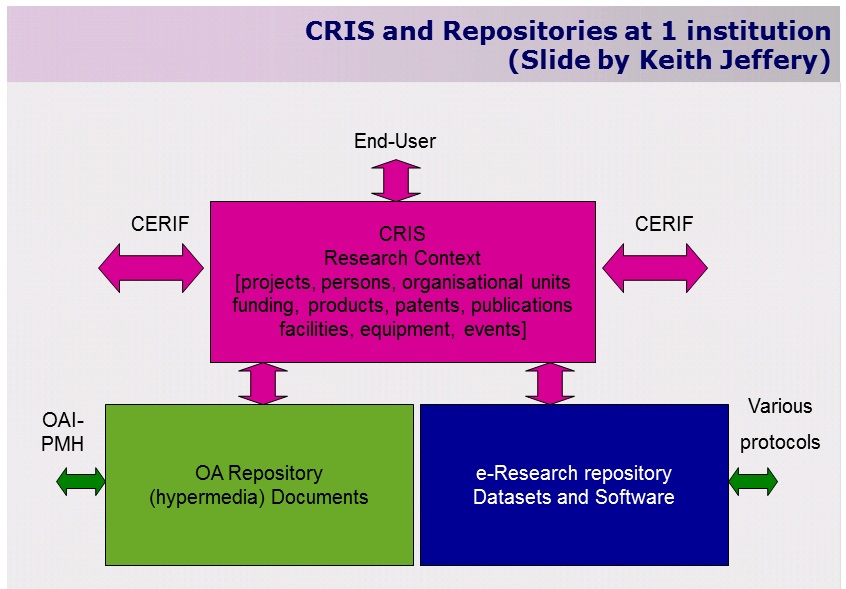
An euroCRIS Overview Session followed the CERIF Tutorial, along which different members of euroCRIS Board reported recent activity. Keith Jeffery highlighted the euroCRIS Rome Declaration on CRIS/IR integration issued earlier this year and mentioned that while CERIF can generate multiple metadata standards such as DC, MODS, etc, OAR usual qDC-based metadata model was insufficiently accurate, so some integration should be seeked along the model CRIS-Publications OAR-Data/Software OAR.


Other euroCRIS-related activity includes EU FP7 OpenAIRE Project moving from qDC to some semi-CERIF standard, as well as the fact that OpenAIRE+ Project will use CERIF. By definition, CERIF serves a multiple-institution scheme (thus allowing for wider context-related information sharing for purposes such as the Research Excellence Framework assessment in the UK), so there’s also a clear need to operate internationally as to demonstrate CERIF interoperability capabilities.

Harry Lalieu, euroCRIS Secretary, announced CRIS2012 Conference to be held in Prague next June, and 2012 euroCRIS membership meetings, which will tale place in Prague just before the CRIS2012 event and possibly in Spain later next year.

Anne Asserson, Universitetet i Bergen and responsable for euroCRIS strategy, announced dataset management as the next environment CERIF will be next moving into (with projects such as University of Sunderland-led CERIF for Datasets paving the way for such move).

Speaking on behalf of Ed Simons, Universiteit Nijmegen and euroCRIS website manager, Keith Jeffery informed the audience a test CRIS is being planned for inclusion at the euroCRIS site, thus allowing for future live-demoing and functionality analysis.

Within the euroCRIS Task Group reports, Brigitte Joerg mentioned the euroCRIS Board-authored paper “Towards a Sharable Research Vocabulary (SRV) - A Model-driven Approach” having been presented at the Metadata and Semantics Research Conference (MTSR 2011) held last October in Izmir, Turkey. A preliminary meeting with Virtual Open Access Agriculture & Aquaculture Repository (VOA3R) Project was also recently held in Madrid in order to plan the future euroCRIS Linked Open Data (LOD) Task Group.

Nikos Houssos, NDC Athens and Task Group Projects leader mentioned running EC FP7 Projects euroCRIS is involved into, such as ENGAGE, dealing with Open Access to Public Sector Information, EuroRIs-Net, one of whose outputs is providing an online CERIF database of RI stakeholders, and OpenAIRE+. UK/JISC Projects such as CERIFy, CRISPool, BRUCE, IRIOS, MICE or RMAS were also cited as a proof of CERIF gradually becoming a common standard for RIM Programme Projects. Many of those projects are having an active euroCRIS involvement.

Danica Zendulková, CVTISR and CRIS-IR Interoperability Task Group leader, announced upcoming TG work along lines such as defining usecases for CRIS/IR interoperability, defining a model of integration interface (including XML data exchanges and web services), implementng an authority file model with attached persistent ID and promoting cooperation between CRIS/OAR communities.

Finally, David Baker, CASRAI and euroCRIS Architecture Task Group manager explained the way towards the Reference CRIS implementation. According to implementation plans, a test CRIS should be available at the euroCRIS site on June 2012.

Several sessions –see euroCRIS meeting presentations- followed the euroCRIS Overview, summarizing recent and forthcoming developments in CRIS and CERIF implementation. An interesting discussion was also held, led by Joachim Schöpfel, on teaching CRIS Systems to his Information Science students at Université de Lille and on potential CERIF application to the teaching environment and scholarly activities beyond research.

A particularly relevant presentation –as it described CERIF-based CRIS implementation in the UK, where CERIF standard adoption has been most successful so far– was UKOLN Rosemary Russell’s “CERIF UK landscape” (final report to be formally published later this year by UKOLN-University of Bath). Some figures were mentioned at the presentation: 17 PURE/Atira CERIF-based CRIS were implemented in the UK along last year, plus 5 Converis/Avedas CRISes and a large number of Symplectic Elements.


The CERIF UK Landscape Project carried out a set of seven interviews among ‘CRIS Project managers’ from different institutions - based at the institutional Research Office (2), Library/Info Services (4) or IT Department (1)- in order to gather their views on the implementation process, CRIS reception by end-users (researchers) and staff, plus experience on CERIF and integration with Institutional Repositories. A summary of the –often not so encouraging– answers is available at the presentation, CERIF being perceived by many as a far too complicated standard whose management would rather be handed over to the CRIS commercial provider. It is a fact however that institutions running a CERIF-based CRIS are in a much better position to deal with the REF requirements.

Monday, 29 August 2011

Research data management in crystallography at the XXII IUCr Congress


  On Aug 29th a session on research data management will be held at the XXII Congress of the International Union of Crystallography (IUCr2011). The session will feature talks by Brian McMahon (IuCr), Brian Matthews (I2S2 Project), Peter Murray-Rust (CrystalEye), John Westbrook (wwPDB) and Nick Spadaccini (DDLm). Peter Murray-Rust will deliver a talk along the session on Open Crystallography.

Friday, 26 August 2011

STM research data management and the Quixote Project


  A one-day seminar was held yesterday Thu Aug 25th at the Zaragoza Scientific Center for Advanced Modeling (ZCAM) on research data management and the Quixote Project for data management in Computational Chemistry. The session, entitled “Research data management: The experience of the Quixote project for Quantum Chemistry data. Can it be extended into a collection of research data management repositories?”, was attended by a rather diverse group of researchers (both computational chemists and from other disciplines) and repository managers, aiming to learn about research data management initiatives and specifically about the progress of the Quixote Project, in which two researchers from the University of Zaragoza and the CSIC Institute of Physical Chemistry "Rocasolano" are involved.

The Quixote Project (see paper "The Quixote project: Collaborative and Open Quantum Chemistry data management in the Internet age", in press with the J Chem Inf) is developing the infrastructure required to convert output from a number of different molecular quantum chemistry (QC) packages -such as NWChem or Gaussian- to a common semantically rich, machine-readable format and to build repositories of QC data results.

The session started with an introduction to "STM Research data management initiatives in Spain and abroad" delivered by SONEX member Pablo de Castro, in which different national approaches to RDM were presented based mainly on the information collected at the JISC MRD Programme International Workshop held last March in Birmingham.

Different approaches to data management taken from the JISC and SURF Foundation were discussed at Q&A time: for the JISC, datasets are assets per se, regardless of where they are attached to a research paper as supplementary material, whereas the 'Enhanced publication' approach from the SURF Foundation in the Netherlands, regards datasets mainly as digital objects connected to research publications. Some emphasis was made on the fact that the upcoming OpenAIREPlus European project shares the SURF approach.

Two presentations on the Quixote Project followed, "From Databases in QC 2010, ZCAM, Sep 2010 onwards: a brief history of Quixote" by Jorge Estrada and "The Quixote Project: a pioneering work in managing Computational Chemistry research data" by Pablo Echenique. Both Quixote project members explained the results, the challenges and the cooperation opportunities of this non-specifically-funded RDM project, engaging in a fruitful dialogue with the attending researchers and repository managers on how the QC data assets could be best managed.

Finally Peter Murray-Rust closed the morning interventions with some reflections on the subject "Entering a new era in data management" - see his blogpost for a summary of his ideas.


In the afternoon there were joint debates on how to improve implementation of research data management initiatives. Researcher motivation for dataset sharing was extensively debated: this motivation should ideally not just arise from a given funding agency actually requiring those data to be made available, but from the sheer advantages (as summarized by Peter Murray-Rust) that doing so would bring to the research practice and communication ("improving methodology").

An independent debate session was held for discussing how to start developing some kind of research data management infrastructure in those countries where work in this area is presently beginning. These are some recommendations that were put together by the participants in the debate:

- Some workgroup of (not just library-based) IT professionals should be put together for analysing the current infrastructure and the opportunities for launching new initiatives upon potentially reusable pre-existing ones,

- It would be advisable to analyze the researcher behaviour and needs in terms of storing their datasets into international platforms for data sharing (in case they are available for their specific discipline),

- It would be interesting to examine the motivation for data sharing from research groups in different research areas, so that initial efforts to develop data management infrastructures can start working with those areas more willing to share their data (Earth Sciences recurrently showing up when analysing the international perspective),

- Pioneering initiatives for providing services to STM researchers regarding data handling and storing from given Institutional Repositories (such as eSpacio UNED and Digital.CSIC) should be highlighted as a role model to be spread,

- The OpenAIREPlus/SURF Enhanced papers approach could be a good starting point for Institutional Repositories to work at, by finding out which of their presently filed papers have supplementary data attached at the journal site and trying to independently manage those ones,

- A need was detected along the session talks with researchers for a dataset management system at research centres for basic internal organisation purposes. Datasets filed in this internal storage system may or may not be aimed for publication,

- Production and publication of potentially citable datasets should be acknowledged as a relevant scientific contribution for research assessment purposes,

- There are big differences in needs, procedures and required infrastructure regarding data management between Big Science and long-tail science (the greater part actually being groups of three researchers in a lab with specific needs of their own),

- The Library is a potential supplier of know-how on data processing and storing for researchers, and that role should be promoted within the institutions,

- The Spanish e-Research National Network, mostly dealing with Grid and supercomputing initiatives, might be a good workgroup infrastructure for pioneering data management initiatives in Spain,

- There are real collaboration opportunities between the Quixote Project and the research information management infrastruture at the University of Zaragoza (two IRs being currently available, Zaguan at the University and Digital.CSIC at the Spanish Nacional Research Council, CSIC),

- Research staff (mainly PhD students) getting involved in the management and operation of the dataset information management systems (such as Chempound data repository at the University of Cambridge) seems a prerequisite for the success of the data management initiatives

- Due to the specific data features for various research areas, the incipient data management infrastructure available is more developed for the Social Sciences and Humanities than for STM research areas.

Sunday, 17 July 2011

KULTURising research repositories


  "...I can only add that research for art, craft and design needs a great deal of further research. Once we get used to the idea that we don't need to be scared of 'research' - or in some way protected from it - the debate can really begin."
(Christopher Frayling, RCA Rector (1996-2010), from: "Research in Art and Design" (Royal College of Art Research Papers, Vol 1, No 1, 1993/4). Royal College of Art, London).


  On the Jul 6th meeting at JISC Brettenham House some planning was done as well for Sonex extension besides Swordv2's. In the framework of this project extension, Sonex is expected inter alia to further support the JISC Deposit Projects and continue to gather international deposit use cases, as well as to provide some
recommendations on how to improve deposit.

As part of this further involvement with JISC Deposit Projects, Sonex was attending the Kultivate Project Conference on Jul 15th at the Royal Institute of British Architects (RIBA).


Based at the Visual Arts Data Service (VADS), a research centre at the University for the Creative Arts, and funded by the JISC from late November 2010 to the end of July 2011 within the JISC Deposit strand, the Kultivate Project aims to "share and support the application of best practice in the development of institutional repositories that are appropriate to the specific needs and behaviours of creative and visual arts researchers". Kultivate builds upon the knowledge and experience of the Kultur II group, which grew out of the JISC funded Kultur project (2007-2009). The Group currently consists of over forty institutions and projects and is led by the VADS.

Specific goals of the Kultivate project are:

- to increase the rate of arts research deposit,
- to enhance the user experience for researchers, and
- to develop and sustain a sector-wide community of shared best practice in arts research repositories.

There are significant differences between Kultivate and the rest of the JISCdepo projects (RePosit, DURA and DepositMO) in the sense that while the three other ones deal specifically with semi-automation of widely-recognised content ingest into repositories (mainly by fostering platform interoperability), Kultivate seeks
to extend the coverage of institutional repositories to the creative arts environment, which is both rather different in nature to the mentioned well-accepted research and which hasn't been specifically addressed so far as scholarly output. In this regard, Kultivate can be both seen as sort of an outlier project and as the most challenging of them four.


After eight months of hard work, the Kultivate Project Conference put together a model set of talks and presentations (see programme and updated presentations) to introduce the project outcomes.

Several talks made introductory reflections on what creative arts research should be - with its specific peculiarities. The fact that the output from activities in the creative arts is or is not called research (artists themselves sound a bit surprised sometimes on being called researchers) doesn't seem that relevant anyway - main thing actually being it's scholarly output from many HEIs and Arts Schools, and as such it should be subject to standard deposit into institutional repositories.

However, it is often hard to persuade artists to have their work filed into repositories ("the repo doesn't fit the needs of creative artists" a frequent allegation for not taking part in the project). In this regard, advocacy is particularly critical for institutional projects being carried out in the area - they are breaking through in a discipline where no such thing could possibly exist (so far) as PubMed, Chemical Abstracts or arXiv.

See examples of effective advocacy under the Kultivate project umbrella at Goldsmiths Research Online and UAL Research Online, plus the own Kultivate Advocacy Toolkit, one of the project's main outputs.

Another relevant progress Kultivate is promoting is the setting of metadata standards for description of creative artworks (something that incidentally brings the project closer to the data management strand rather that to the deposit one, making it a quite heterodox one). See for instance 'The listening room' item at UAL Research Online with its four-tabbed description including metadata as well as images and videos (and thus effectively delivering an answer to frequent artists complain on work documentation: "I did a performance, not a video" or "Fine, but where am I?").


Performance Art Data Structure (PADS), for which the unit subject to description is the 'work' not the 'digital object', is yet another solution for complex description of creative arts output developed by the University of Bristol within the JISC-funded CAiRO Project for Complex Archive Ingest for Repository Objects (see example of PADS example record for 'Becoming snail' performance by Paul Hurley at JISC Digital Media).
PADS is also involved in the Europeana attempt to standardise perfomance metadata accross the EU.

Finally, a good (and growing) number of EPrints-based implementations of the Kultur enhancements for designing creative arts output-focussed institutional repositories were presented at the project conference (incidentally arising questions by DSpace-based IR managers on when something similar will be developed for DuraSpace). Kultivate has also provided (in cooperation with the University of Southampton team) a set of technical enhancements to the EPrints platform, among them on the MePrints application and the IRStats package.


Implementation of those enhancements by different institutions (either arts-focussed or general purposed ones with Arts Departments within them) is giving way to a wave of repository KULTURisation (ie being adapted to deal with creative arts output) across the UK that might well spread beyond that once working standards are consolidated. In the meantime the VADS-lead eNova project is already building upon the outputs of both Kultivate and Kultur projects.

Wednesday, 27 April 2011

National initiatives for promoting data management strategies: an overview


- "Hello, I want to deposit my data"
- "Sir, this is a library!"
- "Sorry" -he whispers- "I want to deposit my data".
(as told by Brian Hole, British Library, along his presentation of the DRYAD UK initiative)


  Main objective of the JISC MRD International Workshop held last month was to review progress achieved by the JISC Managing Research Data Programme and to discuss this in the context of broader international developments.

As stated in the workshop programme overview, "this dimension reflects key partnerships which JISC, the JISCMRD Programme and the DCC has been building through the IDCC Conference, the Knowledge Exchange and other initiatives. They include the Australian National Data Service, the NSF funded DataNet Projects, institutions in the US and Australia, the DFG, SURF, DANS etc".

Whithin the broader context, besides a couple of preliminary talks on the European Union approach to (and future funding of) data management initiatives -by John Wood, on the EU 'Riding the wave' report, and by Carlos Morais-Pires on the Digital Agenda for Europe- the workshop featured a specific session on "National and international infrastructure initiatives" whose first panel was called "Approaches and strategies in the UK, US, and Germany". Australian and Dutch national or specific approaches were also discussed, either at this session or later along the event.

Besides the national initiatives featured in this and further sessions along the meeting -it was reassuring to see such a broad scope of strategies or already running projects taking place at the same time in so many different countries- there are also additional, sometimes preliminary initiatives for promoting data management policies at national or institutional level in other countries such as Finland, Portugal, France, Poland or South Africa.

As new initiatives for research data management keep steadily coming up, this session was an opportunity to get an informal update on DCC's report 'Comparative Study of International Approaches to Enabling the Sharing of Research Data' - see its summary and main findings here as of Nov 2008.

Digital Curation Centre - UK
Kevin Ashley, Digital Curation Centre (DCC), described the present picture of data management in the UK as "a new context", where Universities are increasingly willing to take responsibility for data management (specially in areas not covered by Data Centres).
Once UK funder and NSF rules for Data Management Planning are being implemented, this in-advance planning is becoming very important for funders, researchers, institutions, collaborators and reusers. DCC current tasks include integrating different Data Discovery Services plus building institutional capacities: skills, policies, etc. Besides that, DCC is providing the new DMP Online service aimed to produce and maintain Data Management Plans.
Good news is that, despite varying degrees of involvement, institutions in the UK have accepted their role in RDM.

NSF-funded DataNet Projects - US
A summary of present state of research data management in the US was provided by presentations of the DataONE and DataConservancy initiatives, resp. delivered by William Michener (University Libraries at U New Mexico) and Sayeed Choudhury (Johns Hopkins University).

After stating that "researchers are presently using 90% of their time managing data instead of interpreting them", W. Michener presented the Data Observation Network for Earth (DataONE) initiative (a live DataONE presentation at U of Tennessee is available). This NSF-supported initiative aims to ensure preservation and access to multi-scale, multi-discipline, and multi-national science data. DataONE Coordinating Nodes around the world will help achieving needed international collaboration for solving the grand science and data challenges, particularly with regard to education.

The DataConservancy initiative aims to research, design, implement, deploy, and sustain data curation infrastructure for cross-disciplinary discovery with an emphasis on observational data. S. Choudhury's presentation stressed the need for data preservation as a necessary condition for data reuse and introduced the recent connection of data and publications through arXiv.org as one of the pilot projects that build upon the Project APIs.

DFG - Germany
New DFG information infrastructure projects in Germany were presented by Dr Stefan Winkler-Nees, who mentioned both Jan 2009 DFG Recommendations for Secure Storage and Availability of Digital Primary Research Data, as a base report for promoting standardized work in the data management area, and DFG running call for proposals "Information infrastructures for research data". Selected projects at this call are due to be shortly announced and will start on May/Jun'2011. Finally, in a a common line of thought with other initiatives, Dr. Winkler-Nees mentioned DFG is aiming for teaching and qualification of both researchers and data curators.


SURF Foundation & DANS - The Netherlands
Later on along the workshop, John Doove presented the SURF Enhanced Publications initiative within the SURFshare programme 2007-2011. Six new projects funded along 2011 by the SURF Foundation will allow researchers from a variety of disciplines to share datasets, illustrations, audio files, and musical scores with fellow researchers in the context of Enhanced Publications (programme video available on YouTube). There were already two previous grants rounds for Enhanced Publications. The six running projects, whose results are due in May 2011, take place within five disciplines: Economics (Open Data and Publications, Tilburg University), Linguistics (Lenguas de Bolivia, Radboud University Nijmegen, and Enhanced NIAS Publications, KNAW-Royal Netherlands Academy of Arts ans Sciences), Musicology (The Other Josquin, University Utrecht), Communication sciences (Enhancing Scholarly Publishing in the Humanities and Social Sciences, KNAW) and Geosciences (VPcross, KNAW).

The Dutch strategy for increasing research data available online was completed with the presentation "Sustainable and Trusted Data Management" delivered by Laurent Sesink (DANS-Data Archiving and Networked Services). DANS, est. 2005, deals with storage and continuous accessibility of research data in
the social sciences and humanities and promotes the 'Data Seal of Approval' for certification of data repositories, guaranteeing via a series of required criteria a qualitatively high and reliable way of managing research data.

Australian National Data Service (ANDS) - Australia
Finally, Andrew Treloar, Director of Technology, Australian National Data Service (ANDS), supplied a comprehensive perspective from a national infrastructure provider and in a way summarized previous talks by saying that, despite differences, there are common themes emerging in national approaches to data management, as there are things only they can do. Along his plenary presentation "Data: Its origins in the past, what the problems are in the present, and how national responses can help fix the future" he mentioned for instance that Hubble Space Telescope-related publication statistics show double research is being done thanks to data reuse. Efficiency, validation, integrity of scholarly records, value for money and self-interest were listed as (non-altruistic) arguments for data reuse.

Having the chance to attend this series of brilliant presentations and checking out how policies for opening access to research data keep spreading over institutions and countries were undoubtedly part of the Birmingham workshop highlights. Next opportunity for keeping up with it all will be next November at the Knowledge Exchange Workshop on Research Data Management in Bonn, Germany.

Monday, 25 April 2011

Could external cooperation improve collection of specific JISC MRD project-related information?


  In forthcoming days SONEX will be publishing some posts on the JISC MRD Programme International Workshop held last March 28-29th at Aston Business School Conference Centre, Birmingham. Certain aspects debated at this comprehensive meeting were very useful for establishing an approach for dealing with research data management from a SONEX viewpoint, as debated in a SONEX meeting at EDINA on Mar 30th whose outcome will also be shortly blogged.

See IUCr Brian McMahon's report for a general review on the JISC MRD workshop.

One of the most visible disciplinary approaches to data management presented at the JISC MRD event -which featured all kinds of institutional and subject-based initiatives in the area- was the one coming from meteorology, palaeoclimatology and climate-related sciences: there was a presentation of the PEG-BOARD Project (U of Bristol) at the Subject-Oriented Approaches session on Monday, followed by ACRID (U of East Anglia & STFC) and Metafor (BADC & STFC) Project presentations on Tuesday afternoon.

One of the most relevant features of these climate-related projects is interdisciplinarity. PEG-BOARD Project in particular aims to serve the archaeology research community by supplying them their paleoclimate data.


A few specific aspects about PEG-BOARD were discussed after the project presentation. Interesting thing about them is they were not mentioned along the talk, nor are they reported at the project site:

- Due to the project interdisciplinarity, there are two clearly different user groups for palaeoclimatology data produced: climatologists, who will understand the nature of involved datasets, as they're central to their discipline, and archaeologists, who don't and need not know much about the data format but need the information contained in it for their own purposes - thus functioning as regular non-technical users to the project instead of researchers. However, as they are indeed researchers, the feedback they may provide on the project outcome could be so much more valuable.

- What archaeologists care about in the end is the data plottings, and Data Centres will not provide such processing. So what PEG did was implement specific software capabilities that will address the needs of non-technical data users (i.e. archaeologists), as to allow them to search for the plots or false-colour graphics they need. This piece of middleware is a conceptual key feature of the project in terms of deliverables.

- Climate data is usually archived in binary format, so it's often not easy to process. UK Met Office provided lots of info, often incomplete or in old formats. The adaption process of raw data to the project needs was very interesting and worth disseminating.

- Climate models were written in FORTRAN. When re-written or translated into C++, the results would vary for the same data arrays due to specific treatment by the code. That poses a quite amazing challenge in terms of model interpretation.

- When asked on whether researchers provided enriched metadata for their data, the answer was there's usually an input in terms of past experiments, i.e. "this is the data outcome of such and such experiment when changing initial conditions in such a way". Such-and-such experiment would be described the same way until one was reached that wasn't described at all.

The fact that none of these project aspects is recorded or discussed at the project blog poses a question on whether an external approach to data management projects might collect and disseminate very interesting information that researchers may not consider relevant enough to discuss from project blogs. Such an external approach to running projects might be carried out by data librarians in order to
share these specific project details with the data management community.

For whatever it may be worth, Sonex would be keen to do this kind of job for the MRD community.

Sunday, 16 January 2011

"On such a full sea are we now afloat"

Such quotation -from W. Shakespeare's 'Julius Caesar'- closed Drs. Eefke Smit's talk "Taking the Current when it Serves: Research Data from the Publisher's Perspective" she delivered along 'Academic Publishing in Europe': the APE 2011 conference, held at the Berlin-Brandenburg Academy of Sciences in Berlin, Jan 11-12th, 2011.


Aiming to gather some facts for its ongoing analysis on research data management and its deposit into repositories, Sonex just attended APE2011, a meeting for the publishing industry and its environment held yearly in Berlin since 2006. The conference organisers do regularly publish a brief official report shortly after the event celebration (reports on previous APE editions
available here, report on this edition due shortly).

This particular visit to Berlin offered the chance to attend yet another event besides APE2011: the SOAP Symposium. Final report by the SOAP (Study of Open Access Publishing) project survey was presented along this one-day meeting, held on Jan 13th in the Goethe Room of the renowned Harnack-Haus in Berlin. The SOAP project describes and analyses the open access publishing landscape as well as exploring the risks and opportunities of the transition to open access publishing for libraries, publishers and funding agencies - see preliminary survey results, final report will be available as of next March.

The conference programme for APE2011, entitled "Smarter Publishing in the New Decade", included promising topics such as evolution of peer-review and ways to improve it, the so-called data deluge, business opportunities in China and how Open Access is becoming increasingly mainstream within the publishing environment. Discussions on those matters were lively both at round tables and at lunch pauses. Sonex interest being mainly on research data management, this report will subsequently focus on presentations and debates on the subject.

On Tuesday Jan 11th afternoon, a session was held on “The Data Deluge: to Drown or to Swim?”, chaired by Bob M. Campbell. Herbert Gruttenmaier, INIST-CNRS, started his presentation "Helping to Ride: a look at data sharing and access policies" by reminding that, since we were in Berlin, the definition of an Open Access Contribution on page 1 of the Berlin Declaration on Open Access to Knowledge includes “raw data and metadata”. Some highlights from his talk were:


  • There is a large number of Data Sharing Policies being defined by administrations, institutions, funding agencies and publishers themselves under the guideline "data should be made as freely and widely available as possible". See for instance NSF’s requirement for submission of data management plans of May 10th, 2010, under general policy statement “Investigators are expected to share with other researchers, at no more than incremental cost and within a reasonable time, the primary data, samples, physical collections and other supporting materials created or gathered in the course of work under NSF grants”.
    Or the very recent (Jan 10th, 2011) commitment by a group of major international funders of public health research to “work together to increase the availability of data emerging from our funded research, in order to accelerate advances in public health”.

  • Publishers such as BioMed Central were featured as high-profile supporters of Open Data (see Dec 11th, 2010 post at this blog), and NPG editorial policy on dataset sharing was specifically mentioned along the talk, as well as the Brussels Declaration on STM Publishing statement that “Raw research data should be made freely available to all researchers”. Finally, discipline-based data policies such as PaN-Data Scientific data Policy Draft for Scientific Data Management Framework at European Photon and Neutron Facilities or the Joint Data Archiving Policy (JDAP) adopted in a coordinated fashion by Dryad partner journals.

  • Not everything is that simple though: the Nov 2009 "Patterns of information use and exchange: case studies of researchers in the life sciences” RIN report shows that researchers are not so eager to share their data with others, and that ‘one-size-fits-all’ information and data sharing policies may not achieve the goals there are aiming for, namely scientifically productive and cost-efficient information use in life sciences.

Drs. Eefke Smit, International Association of STM Publishers, provided a counterexample for these growing data sharing policies by publishers along her talk on "Research Data from the Publisher's Perspective" by describing the Journal of Neuroscience policy of no longer taking supplementary material from authors since Nov 1st, 2010, the procedure posing too heavy a burden on paper reviewers.
She also warned of the so-called data deluge, according to which tera- and petabite sized datasets will increase their share in research projects in upcoming years.
However, when researchers are asked where they would like to submit their research data, the answer is more often than not "publishers". This brings along the issue of research data preservation: results of an internal survey by STM Publishers show what she called “an improvable situation” with regard to preservation.

Planned talk “Data Publishing in the Context of the ICSU World Data System” by Dr. Michael Diepenbroek, Director of WDC-MARE/PANGAEA, University of Bremen, went finally off the conference programme. However, the next speaker, Dr. Jan Brasse, Managing Director of DataCite, provided some information on the progress of one of the main databases for research data in the geosciences area, by for instance stating there was “a wide cooperation between Elsevier and PANGAEA via DOI-based external links from online papers” at the former’s platforms. This kind of cooperation between publishers and international databases for handling research data might be useful for tacking the abovementioned data preservation issues.
Dr. Brasse, affiliated with the German National Library of Science and Technology Hannover, described as well the evolution of the DataCite international project as it gets carried out by local member institutions: as of Dec’10, over 1M records are already registered with DOI names at datacite.org. Perspectives for the project include setting up of a Central Metadata Base as of Jun'11; DataCite becoming a harvest point for third parties such as WoS; and cooperation via CrossRef for data-article lookup.

The data management session ended with the talk on “Managing Publication and Research Data: the eSciDoc Research Infrastructure” by Dr. Malte Dreyer from Max Planck Digital Library (MPDL). eSciDoc is as a joint project of the Max Planck Society and FIZ Karlsruhe, funded by the Federal Ministry of Education and Research (BMBF), with the aim to realize a next-generation platform for communication and publication in research organization. Further eSciDoc projects mentioned along the presentation and dealing with research data management were ‘Astronomer‘s Workbench’ (astronomy), Lifecycle Logger (biochemistry) and BW-eSci(T) for computational linguistics. DARIAH (Digital Research Infrastructure for the Arts and Humanities) –in whose development eSciDoc is directly involved- and CLARIN (Common Language Resources and Technology Infrastructure) projects were repeatedly highlighted along the session as leading EU projects on development of digital research infrastructure (including data management) for the Humanities and Social Sciences.


A joint panel discussion was then held after the presentations on research data management, with speakers taking questions from the floor. Alicia Wise, Elsevier Director of Universal Access and former archaeologist raised the issue of costs attached to research data management and who should fund them: it was agreed by the panellists that national funding bodies should assume the cost of data management. Along her question Dr. Wise incidentally mentioned that data management at the archaeological research project she used to work for succeeded only thanks to researchers dedicating 50% of their time to data curation. This aspect of dataset deposit will be examined by Sonex in order to identify alternative (automatic) curation procedures currently being used to relieve researchers of the data curation burden.

The data management issues extended well outside the session specifically devoted to them and into the Innovation session held next day, where Portland Press Adam Marshall presentation on the Semantic Biochemical Journal and Project Utopia at the Manchester School of Computer Science did extensively deal with data handling (see “Calling International Rescue: knowledge lost in literature and data landslide!” at Biochem J. (2009) 424, 317–333 for a review on “how to provide new ways of interacting with the literature, and new and more powerful tools to access and extract the knowledge sequestered within it”).

At the end of the data session panel discussion Dr. Eefke Smit synthesized the three challenges of research data management: normalization, standardization and migration. She did also remind the audience of verses following the one quoted in the title of this post:

(…) On such a full sea are we now afloat,
And we must take the current when it serves,
Or lose our ventures
.

Saturday, 18 December 2010

Sonex at the "Digital Library Research and Open Access: Interoperability Strategies" workshop

After delivering its paper "Handling repository-related interoperability issues" last Sep at the 2nd DL.org workshop in Glasgow, Sonex will be contributing a presentation at the forthcoming DL.org "Digital Library Research and Open Access: Interoperability Strategies" one-day event to be held at the British Academy in London next Feb 4th.


Sonex contribution will be part of this DL.org workshop dealing with digital libraries, Open Access repositories and interoperability among them. Already available conference programme includes presentations on DL. org reference model, DL.org policy and quality interoperability survey, degree of progress of Open Access repositories with regard to interoperability issues in the UK and Europe and research data library management among others.

Wednesday, 6 October 2010

SONEX presentation in Valencia, Spain


The 10th REBIUN Workshop on Digital Proyects will be held Oct 7-8, 2010 in Valencia, Spain. Among the technical presentations scheduled for the workshop, there is one on Sonex called 'Interoperabilidad y Repositorios: el Grupo de Trabajo SONEX' (Interoperability and Repositories: the SONEX Workgroup).


In the Sonex presentation, to be delivered on Thu Oct 7th, the main Sonex worklines will be discussed, as well as incipient implementations of Sonex usecase scenarios in Spanish Institutional repositories.

Tuesday, 14 September 2010

Sonex presentation at the 2nd DL.org workshop on Digital Library Interoperability

(picture by: Anna Nika, University of Athens)

The paper 'Handling Repository-Related Interoperability Issues: The Sonex Workgroup' was presented last week at the 2nd DL.org workshop held in Glasgow in conjunction with the 14th European Conference on Digital Libraries (ECDL2010, Sep 6-10, 2010). The DL.org workshop was scheduled under title "Making Digital Libraries Interoperable: Challenges and Approaches" and it featured several presentations by DL.org working groups on the DL Reference Model, such as DL content, functionality, users, architecture, quality & policy (see programme). An invited talk by MS Research Alex Wade, "Digital Library Interoperability: An Industrial Perspective", was also held, where most recent MS developments in the area of DL interoperability were summarized (Zentity, Article Authoring Add-in for Word, DepositMO Project, MS Academic Search or the WorldWide Telescope among others).

The Sonex presentation was delivered on Fri Sep 9th by Peter Burnhill and Pablo de Castro along the workshop's Day I. Sonex approach to interoperability being quite pragmatic in scope, it fitted in well alongside DL.org's more theoretical-founded model. Complementary approaches by both initiatives may in fact offer perspectives for further collaboration between them after this DL.org workshop.

Friday, 3 September 2010

RepoFringe 2010: lots of interesting presentations plus a Sonex Pecha Kucha

The 3rd edition of the Repository Fringe was just held in Edinburgh along Sep 2nd and 3rd 2010. This new edition of the RepoFringe (see programme) was a good opportunity to learn about the most recent advancements regarding repositories in the UK, and new ideas for their development were shared in an informal, stimulating atmosphere. This edition's success story was undoubtedly EPrints Bazaar app-store for its new version 3.2, as live demoed by David Tarrant and Patrick McSweeney, with Les Carr's cooperation as an inspired pre-recorded speaker. EPrints will also shortly release its CERIF4REF plugin in order to comply with the R4R schema, thus proving that repository software is swiftly progressing towards anticipating user needs by closing the gap with CRIS systems from a research output perspective.

Further talks were also held at RF2010 on CRIS systems and IRs. A lot of universities do already have CRIS systems running, and some voices in the community start wondering whether CRIS systems might eventually replace institutional repositories as an "entrance door" to the institutional research output. Projects like RePosit (see Queen Mary University of London Sara Molloy's presentation for more info) on the contrary are exploring ways for batch ingestion of contents flowing from CRIS systems into a currently low-populated array of repositories.

Quite a number of other subjects were amusingly dealt with by other speakers, such as timestamping the web through the Memento project as presented by Herbert van de Sompel (LANL), Topic Models by Michael Fourman (University of Edinburgh Informatics Dept), or Repositories and data at Closing Keynote by Kevin Ashley (DCC).

RF2010 had also its traditional 20-slide-20-secs-per-slide Pecha Kucha sessions once again. There was a Pecha Kucha on the work by Sonex on Fri Sep 3rd, and projects like Enlighten, Jorum, Open Access Repository Junction, ERA, ShareGeo and some others were represented at this light speed presentation variety as well.


On Sep 1st a SHERPA RoMEO API workshop was also held by Peter Millington, Jane H. Smith and colleagues from Nottingham at the e-Science Institute facilities in Edinburgh as a RepoFringe pre-event. As presented last July at Open Repositories Conference in Madrid, major improvements in the RoMEO service are being worked at, and this workshop was an opportunity to get feedback from the RoMEO API users on its performance and suggestions on possible enhancements for version 3 currently in its final stages of development (due Autumn 2010). There were also interesting presentations from outside the UK on the implementation of RoMEO mirrors such as SHERPA RoMEO deutsch in Germany and service internationalisation was extensively discussed along the meeting (Portugal and Spain were scoped as potential areas for development of specific interfaces). An online survey on the RoMEO API was previously distributed among the workshop delegates and its results were discussed and analysed in fruitful specific breakout sessions.

From a Sonex perspective, the RoMEO service does fit into the Sonex proposal for a distributed national- or regional-level automatic ingest system based on an array of brokers dealing with publisher- or funder-driven ingest of contents into a network of national or regional institutional repositories. From this point of view, RoMEO, such as other general-purpose services as OpenDOAR or the broker itself, are pieces of the required infrastructure for this approach to grow real. Find more information about this Sonex proposal in the Sonex paper 'Handling Repository-Related Interoperability Issues: the SONEX Workgroup' to be presented in Glasgow later this month at the 2nd DL.org workshop "Making Digital Libraries interoperable: challenges and approaches".


Friday, 2 July 2010

Some topics for Sonex BoF at OR10

Place, date and time for Sonex Bird-of-Feather session to be held next week at Open Repositories Conference 2010 in Madrid are already set: Sonex BoF will take place next Wed July 7th at Room "Reino Unido B" from 17:30 to 19 hrs.

Here are some topics to be discussed along the session:

  • The growing number of deposit-related initiatives and events should be properly summarized, classified and advertised somewhere: the Sonex website could widen its present coverage in order to play that role, especially in the US & Canada (out of Europe would probably be more accurate, Berlin 8 Open Access conference 2010 being held in Beijing next Oct), for keeping an eye on progresses wherever they may take place. Some ideas are already available.

  • Main classes of deposit-related initiatives: Publisher-driven & CRIS transfers. Is the Sonex classification thorough enough? Are there any other possible groups that weren't accounted for and left under the 'Other' general section? Are all classes being adequately covered by some ongoing deposit-related project? What about e-Research repositories (datasets + software)? Could they be the [Sonex] missing piece of the institutional research systems integration jigsaw? Input on the issue by a representative of some related initiative attending the BoF could help.

  • Common challenges in publisher-driven deposit initiatives. Re-usable procedures: NLM DTDs. The filtering strategy. SWORD endpoint (scarce) implementation and how OpenDOAR/ROAR may help. Author and institution persistent identifiers. Processing of citations. Everything being developed at the same time doesn't make things easier.

  • CERIF as a spreading standard for CRIS/IR integration. Different ways for achieving the objective, and how the REF affects the whole environment. Hybrid CRIS/IRs: an alternative procedure.

Tuesday, 8 June 2010

CRIS2010 Aalborg: a brief report

The 10th International Conference on Current Research Information Systems (CRIS2010), "Connecting Science with Society: The Role of Research Information in a Knowledge-Based Society", was held last week (June 2nd-5th) at Aalborg University, Denmark. Organised by the euroCRIS association, the conference "aimed to give insight into the role of CRIS in terms of shaping the research agenda and transferring research outcomes from the laboratory to areas of usage and application". Updated information on projects and initiatives for devising CRIS-based National and Institutional Research Information Systems was presented, see conference programme. CRIS2010 presentations will be shortly posted at the conference website.

Some comments below on the outcome of discussions at CRIS2010:

  • All across Europe and beyond, CERIF is spreading as an increasingly accepted standard for building Current Research Information Systems (CRIS) both at national and institutional levels. Previously existing databases and management systems at HEIs are frequently undergoing adaption to CERIF.

  • CERIF-based National Research Information Systems for research management and assessment (such as NARCIS in The Netherlands, Frida in Norway, U-GOV in Italy or the USDA-CRIS in the United States) usually rely on CERIF-compliant Institutional CRISs for supplying the underlying institutional information. This often leads to a two-way strategy for infrastructure development, where National and Institutional Systems are simultaneously being built.

  • As a consequence, there is an increasing number of CERIF-compliant National Research Information Systems in operation, and more of them are in progress (eg DeGóis in Portugal or SEMAT in Iran).

  • At institutional level there is also a growing trend towards adoption of CERIF-based solutions, either developed inhouse or based on CERIF-compliant commercial CRISs: there are already several examples of ePrints being upgraded to PURE (presently the most successful of such commercial solutions) in the UK and elsewhere. This trend leads to a variety of resources available at institutional level depending on the adopted strategy: some institutions have plain CRIS systems, others work with CRIS/IR integrated solutions and finally there are also some universities running CERIF-based enhanced-IRs.

  • The Common European Research Information Format (CERIF) is by no means a closed standard at this point, but it benefits from interaction with existing National, Subject and Institutional Research Information Systems in order to "epitaxially" enrich its description features for providing solutions to various system needs.

  • A wide array of commercial solutions is presently flourishing around the area of institutional research system implementation or enhancement, such as Atira PURE, Avedas Converis or Symplectic Repository Tools to mention just some examples.

  • There are interoperability issues still to be tackled at various points of CRIS/OAR and CRIS/CRIS integration, but remarkable progress is underway, both from publicly-funded international projects and from private companies.

  • The presently soundest example of Author ID standard, Dutch DAI, having been driven by institutional integration purposes, CERIF & euroCRIS initiatives could possibly bring in a new momentum for solving pending Author ID issues, as it is a basic requirement for operation of both National and Institutional Research Information Systems.

  • Despite the fact that "everything being seemingly developed at the same time doesn't make things easier" (quote from Sonex BoF at OR10 preliminary list of issues), important progresses are clearly taking place worldwide on the field of research information system implementation. Some integrated research system development strategy from planning bodies, particularly at institutional environments, may therefore be useful for adapting to the rapidly changing landscape.

Wednesday, 26 May 2010

Recently held and upcoming events on CERIF-CRIS/IR integration

An euroCRIS-organised event related to CERIF-CRIS/IR integration was recently held at CNR Rome, Italy, and forthcoming CRIS2010 will be taking place next June 2nd to 5th in Aalborg, Denmark:

  • Workshop on CRIS, CERIF and Institutional Repositories: Maximising the Benefit of Research Information for Researchers, Research Managers, Entrepreneurs and the Public (Istituto di ricerche sulla Popolazione e le Politiche Sociali, IRPPS, Consiglio Nazionale delle Ricerche, CNR, Rome, Italy, May 10-11, 2010).

  • CRIS2010: Connecting Science with Society: The Role of Research Information in a Knowledge-Based Society (10th International Conference on Current Research Information Systems, Aalborg, Denmark, June 2-5, 2010).

Friday, 21 May 2010

Sonex Deposit BoF at OR10 Madrid

The programme of BoF session proposals for Open Repositories 2010 Conference in Madrid was just released. There will be a Sonex Deposit BoF taking place along the conference (final date & location still to be announced), under following guidelines:

Along last year Sonex workgroup has been devoted to analysis of Scholarly Output Notification and Exchange, that is, of potential deposit processes into repositories for scholarly publications from various sources and related interoperability issues. Several relevant usecases have been selected for following their implementation at institutional environments. After recent publication of Deposit call by JISC (Feb’10), Sonex was assigned the new role of providing support and eventual coordination for selected bids. We are therefore inviting colleagues taking part in ongoing or future deposit-related projects to debate on different approaches, common problems and chances for avoiding redundancies among them.

Wednesday, 14 April 2010

Upcoming Sonex-related events

• OR10: The 5th International Conference on Open Repositories (Madrid, Spain, Jul 6-9, 2010)

• CRIS2010: Connecting Science with Society (Aalborg, Denmark, Jun 2-5, 2010)

• Learning how to play nicely: Repositories and CRIS (Leeds Metropolitan University, Leeds, UK, May 7, 2010)

• Repository Multiple Deposit meeting (London, UK, Apr 8, 2010)

• Readiness for REF (R4R) Workshop (King's College London, Mar 23, 2010)

• OpenAIRE Inaugural Conference (Athens, Greece, Jan 13-14, 2010)

• JISC Deposit Show-and-Tell Barcamp (University College London, Oct 12, 2009)