First objective of the JISC-supported Sonex initiative was to identify and analyse deposit opportunities (use cases) for ingest of research papers (and potentially other scholarly work) into repositories. Later on, the project scope widened to include identification and dissemination of various projects being developed at institutions in relation to the deposit usecases previously analyzed. Finally, Sonex was recently asked to extend its analysis of deposit opportunities to research data.


Showing posts with label Research Excellence Framework. Show all posts

Sunday, 6 November 2011

euroCRIS Membership Meeting – Autumn 2011, Lille, France


  On Nov 2-3 the autumn 2011 euroCRIS membership meeting was held at the University of Lille 3 in Lille, France. Attendees from 14 countries (13 European nations plus Canada) met for two days at the Univ-Lille3 Maison de Recherche for learning about the new CERIF 1.3 version (to be released Dec 2011) and the growing number of CERIF-based CRIS implementations in Europe, with a special focus on French ones (see event programme).

Brigitte Joerg, euroCRIS CERIF Task Group Leader and German Research Center for Artificial Intelligence (DFKI), delivered a CERIF v1.3 tutorial at the beginning of the membership meeting. After a general-purpose introduction to CERIF, CRIS Systems and the euroCRIS Group for first-time meeting attendees, the tutorial went into describing new features in the new CERIF 1.3 release (CERIF versions will no longer be named by their year of release as they were so far). Such features include the so-called Infrastructure entities (Facility, Equipment, Service) that have been added to the already existing CERIF Entity Types, namely Base entities (Project, Person, Organisational Unit), Result entities (ResultPublication, ResultPatent, ResultProduct), Second Level entities and Link entities.


Furthermore, the JISC RIM2 MICE Project outcomes (Measuring Impact Under CERIF) have also been brought into the CECRIF 1.3 release under the Measurement & Indicator section. MICE was one of the RIM2 projects –together with CERIFy, BRUCE and IRIOS- presented last September at the JISC programme workshop in Manchester. MICE finished on July 2011 and aimed to “examine the potential for encoding systematic and structured information on research impact in the context of the CERIF schema. MICE aims to build on previous work on impact by producing a comprehensive set of indicators which will then be mapped both to the CERIF standard and the CERIF4REF schema created by the previous Readiness for REF (R4R) Project”. MICE-inspired CERIF 1.3 updates include creation of a new CERIF table, namely the impact measure table, as well as a set of impact indicators: categories that include such concepts as improving performance of existing businesses, improved health outcomes and cultural enrichment. euroCRIS was also involved in the RIM2 UKOLN-led CERIFy Project, dealing with measures of esteem, whose results were as well inspiring for CERIF new Measurement & Indicator definition.

Another new feature for this CERIF release is the Geographic bounding boxes, which will allow displayed information to be restricted to a given geographic area. Geographic bounding boxes are presently defined as squares, thus leaving room for geolocation improvement in future CERIF versions. Finally, a new Linked Open Data (LOD) CERIF Task Group is being planned by euroCRIS.

As a result from this new features, changes in CERIF 1.3 release include a whole set of new entities (such as cfMedium as a new Document Type) and new attributes, as well as removal of some other outdated attributes. The new CERIF version described at the tutorial was a preview, with features such as XML Data Exchange Format Specification and CERIF Formal Semantics still being worked upon until 1.3 version gets finally released next December.

An euroCRIS Overview Session followed the CERIF Tutorial, along which different members of euroCRIS Board reported recent activity. Keith Jeffery highlighted the euroCRIS Rome Declaration on CRIS/IR integration issued earlier this year and mentioned that while CERIF can generate multiple metadata standards such as DC, MODS, etc, OAR usual qDC-based metadata model was insufficiently accurate, so some integration should be seeked along the model CRIS-Publications OAR-Data/Software OAR.
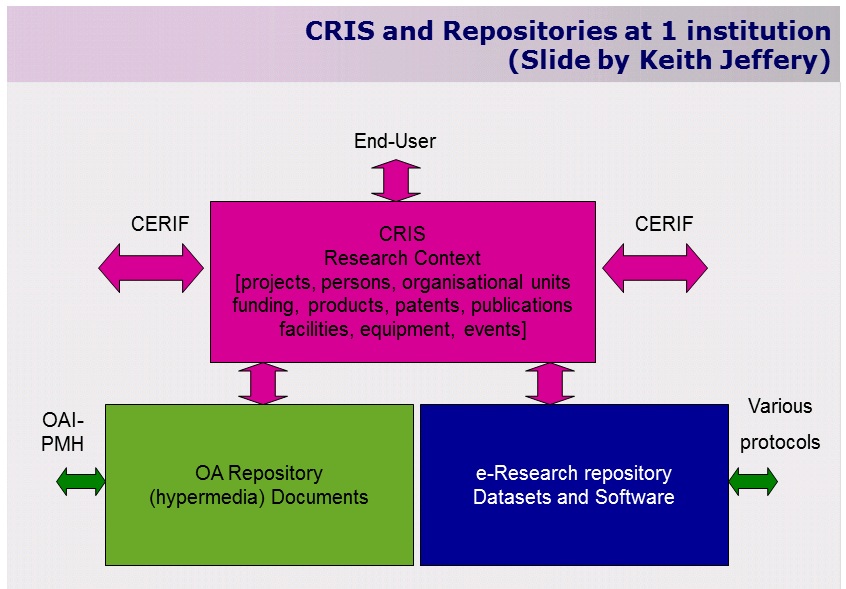

Other euroCRIS-related activity includes EU FP7 OpenAIRE Project moving from qDC to some semi-CERIF standard, as well as the fact that OpenAIRE+ Project will use CERIF. By definition, CERIF serves a multiple-institution scheme (thus allowing for wider context-related information sharing for purposes such as the Research Excellence Framework assessment in the UK), so there’s also a clear need to operate internationally as to demonstrate CERIF interoperability capabilities.

Harry Lalieu, euroCRIS Secretary, announced CRIS2012 Conference to be held in Prague next June, and 2012 euroCRIS membership meetings, which will tale place in Prague just before the CRIS2012 event and possibly in Spain later next year.

Anne Asserson, Universitetet i Bergen and responsable for euroCRIS strategy, announced dataset management as the next environment CERIF will be next moving into (with projects such as University of Sunderland-led CERIF for Datasets paving the way for such move).

Speaking on behalf of Ed Simons, Universiteit Nijmegen and euroCRIS website manager, Keith Jeffery informed the audience a test CRIS is being planned for inclusion at the euroCRIS site, thus allowing for future live-demoing and functionality analysis.

Within the euroCRIS Task Group reports, Brigitte Joerg mentioned the euroCRIS Board-authored paper “Towards a Sharable Research Vocabulary (SRV) - A Model-driven Approach” having been presented at the Metadata and Semantics Research Conference (MTSR 2011) held last October in Izmir, Turkey. A preliminary meeting with Virtual Open Access Agriculture & Aquaculture Repository (VOA3R) Project was also recently held in Madrid in order to plan the future euroCRIS Linked Open Data (LOD) Task Group.

Nikos Houssos, NDC Athens and Task Group Projects leader mentioned running EC FP7 Projects euroCRIS is involved into, such as ENGAGE, dealing with Open Access to Public Sector Information, EuroRIs-Net, one of whose outputs is providing an online CERIF database of RI stakeholders, and OpenAIRE+. UK/JISC Projects such as CERIFy, CRISPool, BRUCE, IRIOS, MICE or RMAS were also cited as a proof of CERIF gradually becoming a common standard for RIM Programme Projects. Many of those projects are having an active euroCRIS involvement.

Danica Zendulková, CVTISR and CRIS-IR Interoperability Task Group leader, announced upcoming TG work along lines such as defining usecases for CRIS/IR interoperability, defining a model of integration interface (including XML data exchanges and web services), implementng an authority file model with attached persistent ID and promoting cooperation between CRIS/OAR communities.

Finally, David Baker, CASRAI and euroCRIS Architecture Task Group manager explained the way towards the Reference CRIS implementation. According to implementation plans, a test CRIS should be available at the euroCRIS site on June 2012.

Several sessions –see euroCRIS meeting presentations- followed the euroCRIS Overview, summarizing recent and forthcoming developments in CRIS and CERIF implementation. An interesting discussion was also held, led by Joachim Schöpfel, on teaching CRIS Systems to his Information Science students at Université de Lille and on potential CERIF application to the teaching environment and scholarly activities beyond research.

A particularly relevant presentation –as it described CERIF-based CRIS implementation in the UK, where CERIF standard adoption has been most successful so far– was UKOLN Rosemary Russell’s “CERIF UK landscape” (final report to be formally published later this year by UKOLN-University of Bath). Some figures were mentioned at the presentation: 17 PURE/Atira CERIF-based CRIS were implemented in the UK along last year, plus 5 Converis/Avedas CRISes and a large number of Symplectic Elements.


The CERIF UK Landscape Project carried out a set of seven interviews among ‘CRIS Project managers’ from different institutions - based at the institutional Research Office (2), Library/Info Services (4) or IT Department (1)- in order to gather their views on the implementation process, CRIS reception by end-users (researchers) and staff, plus experience on CERIF and integration with Institutional Repositories. A summary of the –often not so encouraging– answers is available at the presentation, CERIF being perceived by many as a far too complicated standard whose management would rather be handed over to the CRIS commercial provider. It is a fact however that institutions running a CERIF-based CRIS are in a much better position to deal with the REF requirements.

Saturday, 20 August 2011

Repositories and CRIS: Working Smartly Together


  Due to recent involvement in other OA repository-related activities at the University of Khartoum, reports at this blog on recent events such as the 'Repositories and CRIS: Working Smartly Together' workshop organised by RSP last Jul 19th in Nottingham and the 4th edition of the Repository Fringe in Edinburgh were slightly delayed. Good news about it is that interesting reports on these events have been published in the meantime (see the RSP event review by Gareth J. Johnson at UKCoRR blog). This will allow Sonex to take a different approach to the reporting, making it more of a reflection than of a description, as well as covering the conference followup.

One of the subjects discussed along the Reposit project session within the Conference at EMCC was what mailing list or discussion group should replace the reposit@googlegroups.com forum for discussing IR and CRIS-related issues once the RePosit project comes to an end. Several options were considered, from using already existing lists such as UKCoRR's or ARMA's, to creating a new Super-CRIS list at JISC mail such as cris-super@jiscmail.ac.uk. Steps are being taken after the workshop to make this new list available.

The REF is working as a very strong driver towards CRIS implementation (with CERIF format being extensively considered in order to become a standard, see Marc Cox's presentation). A good number of HEIs do now operate a CRIS as a result (either commercial, in-house built or an extension of their EPrints repository). That is the good news. The not so good ones may be the fact that due to CRIS systems offering an enhanced collection of features, RIM infrastructure managers are starting to wonder whether an Open Access repository (usually managed by the Library) isn't becoming a somehow redundant piece of software, with most of its functionalities being increasingly covered by the CRIS (managed at the Research Offices). Repository phase-out is thus beginning to be discussed at given institutions for integration and optimization purposes. However, as Janet Aucock (University of St. Andrews) writes in the reposit@googlegroups list, even if the degree of overlap between repositories and CRIS systems may be large and growing, there are still features a CRIS will not be able to deliver:

"(...) Another point is to do your homework really well and make absolutely sure that the CRIs can deliver everything that a repository can do. Can it provide established permanent identifiers for items? Can it handle embargoes effectively? What about stats? Does the discovery interface in the portal display all the metadata that you need with regard to open access full text eg rights statements etc. These are small details which we take for granted but are not always embedded into the CRIS. CRIS software is still evolving too, and perhaps not all the functionality necessary is there yet. Another aspect of this is the question of the interfaces for users and discovery. Is the CRIS successfully harvested or crawled by search engines. Is it ranked appropriately. Can it expose metadata appropriately to other services where required? Can it isolate metadata with full text attached/open access full text attached and allow that set to be harvested and reused? We know that our own CRIS supplier is still working on adding all the "repository" functionality that they think is needed for their product. But at the moment I don't know the fine detail of this".

Besides R4R/CERIF4REF Project at KCL mentioned by Marc Cox, other projects also dealing with CERIF implementation regarding CRISes were mentioned such as MICE for Measuring Impact under CERIF, or the BRUCE Project (Brunel Research Under a CERIF Environment) that was presented at the 2011 euroCRIS meeting in Bologna last May (see Sonex post on the two recent euroCRIS meetings in Italy).

Another interesting outcome of this RSP event was the opportunity to learn from local SHERPA RoMEO team about the RoMEO API new v2.8 version and the release of the SHERPA RoMEO Publisher's Policy Tool, that will allow publishers to directly define their RoMEO policies via an embedded portal in SHERPA (actually presented next day, Jul 20th, at the 'RoMEO for Publishers' event in London).

Finally, a poster was featured in the event poster section called “SICA: A CRIS with an embedded Repository working for the innovation in Andalusia Region (Spain)”. With this integrated system for recording scientific production of the researchers belonging to nine universities, research organizations, technology centres and other scientific institutions of the Andalusia region in Spain, the National & Regional CRIS/IR integration initiatives (as recorded by Sonex in its May'2010 post) keep growing. This particular CRIS initiative is being developed within the European SISOB Project on -yet again- how to measure the impact of science in society.

Besides this -not thorough nor systematically updated- Sonex list of National & Regional CRIS/IR integration initiatives, a comprehensive list of 'CRIS + Repositories in the UK' is being put together as a Conference followup. When complete (it's open for any missing one to be filled in) the list will join the RSP Wiki where Institutional Repositories in the UK are already listed as to provide a clear picture of existing infrastructure.

Tuesday, 3 August 2010

IRs as institutional assets for future Research Assessment Exercises

Beyond their relevance for open access dissemination of research output, the new role of Institutional Repositories as a key institutional research infrastructure for present or future Research Assessment Exercises was extensively debated last month at the Open Repositories Conference in Madrid (some good posts on OR10 available at CAIRSS). For this purpose, IRs should be embedded into the general institutional information research system, which brings up a series of integration/interoperability issues that lie at the heart of the Sonex work.

See below an analysis of several CRIS-IR integration possibilities for creating an institutional research information infrastructure that will live up to the challenge posed by future research assessment exercises.


Considerations on the role of CERIF standard were intentionally left out of the picture, as some debate is still taking place on whether or not it should be the base standard for CRIS-IR integration. Most implementations available have until now
chosen CERIF-based integration strategies to tackle the issue, but from ad-hoc light-CERIF versions to non-CERIF solutions whatsoever, there's still a high level of diversity in the way institutions are facing this challenge. At the same time,
CERIF4REF is being steadily worked out at KCL, and CERIF architecture is also being gradually brought into ePrints new versions.

A variety of research information system implementation usecases for RAE/REF purposes was also shown at Peter Burnhill's (Sonex/EDINA) "Repository Update UK" presentation at JISC/CNI meeting last month: from IRs being used as REF-gateways to the challenge it poses in terms of open access availability of contents, a whole set of issues arise as IRs undergo enhancement for fulfilling their new role.

Friday, 2 July 2010

Some topics for Sonex BoF at OR10

Place, date and time for Sonex Bird-of-Feather session to be held next week at Open Repositories Conference 2010 in Madrid are already set: Sonex BoF will take place next Wed July 7th at Room "Reino Unido B" from 17:30 to 19 hrs.

Here are some topics to be discussed along the session:

  • The growing number of deposit-related initiatives and events should be properly summarized, classified and advertised somewhere: the Sonex website could widen its present coverage in order to play that role, especially in the US & Canada (out of Europe would probably be more accurate, Berlin 8 Open Access conference 2010 being held in Beijing next Oct), for keeping an eye on progresses wherever they may take place. Some ideas are already available.

  • Main classes of deposit-related initiatives: Publisher-driven & CRIS transfers. Is the Sonex classification thorough enough? Are there any other possible groups that weren't accounted for and left under the 'Other' general section? Are all classes being adequately covered by some ongoing deposit-related project? What about e-Research repositories (datasets + software)? Could they be the [Sonex] missing piece of the institutional research systems integration jigsaw? Input on the issue by a representative of some related initiative attending the BoF could help.

  • Common challenges in publisher-driven deposit initiatives. Re-usable procedures: NLM DTDs. The filtering strategy. SWORD endpoint (scarce) implementation and how OpenDOAR/ROAR may help. Author and institution persistent identifiers. Processing of citations. Everything being developed at the same time doesn't make things easier.

  • CERIF as a spreading standard for CRIS/IR integration. Different ways for achieving the objective, and how the REF affects the whole environment. Hybrid CRIS/IRs: an alternative procedure.

Wednesday, 14 April 2010

Upcoming Sonex-related events

OR10: The 5th International Conference on Open Repositories (Madrid, Spain, Jul 6-9, 2010)

CRIS2010: Connecting Science with Society (Aalborg, Denmark, Jun 2-5, 2010)

Learning how to play nicely: Repositories and CRIS (Leeds Metropolitan University, Leeds, UK, May 7, 2010)

Repository Multiple Deposit meeting (London, UK, Apr 8, 2010)

Readiness for REF (R4R) Workshop (King's College London, Mar 23, 2010)

OpenAIRE Inaugural Conference (Athens, Greece, Jan 13-14, 2010)

• JISC Deposit Show-and-Tell Barcamp (University College London, Oct 12, 2009)